A First-Morning Plan for an Unfamiliar Commute
Plan an unfamiliar commute with a clear departure point, a route check and a practical fallback, so your first morning feels easier to manage.
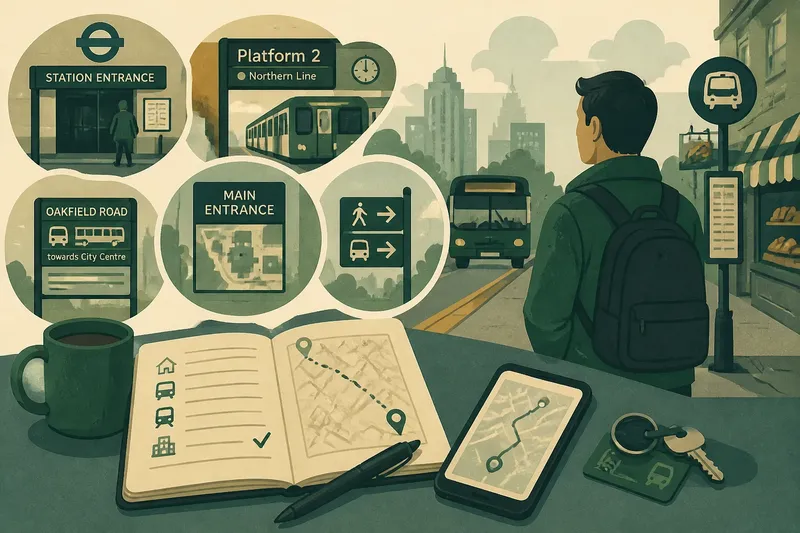
The most common mistake with an unfamiliar commute is treating a route shown on a screen as a complete morning plan. It costs attention at the very moment you need it: you may reach the right street but the wrong entrance, or discover that your chosen stop is difficult to find from your door. A little preparation turns the first journey into a sequence of recognisable decisions.
For an unfamiliar commute, plan around three things: where you will begin, what you will check before leaving, and what you will do if the first option is disrupted. This is not a rehearsal of every possible problem. It is a simple routine that leaves you able to look up, notice the city and respond calmly.
Start with the part of the route that feels least obvious
Before choosing how much to prepare, identify the uncertainty that could trip you up. It might be finding a station entrance, knowing which side of a large road to wait on, or working out how to enter an office complex. The answer should shape your plan more than the route’s apparent length.
If the unfamiliar part is the first few minutes from home, focus on the departure point. If the journey has a confusing interchange, check what you will see when you arrive there. If the final approach is unclear, save a map of the destination block and identify its public entrance. You do not need to memorise the whole city; you need to make the uncertain parts legible.
Use a map app such as Google Maps or Apple Maps to inspect the route, then compare it with the transport operator’s own service information if you are relying on a bus or rail line. The map is useful for streets and landmarks; the operator is the better place to check line names, platform notices or service changes. Where a route depends on local access rules or an operator’s instructions, follow those rather than relying on a map estimate.
Choose a departure point you can recognise
A route needs a start that exists in the real world, not just a blue dot that may drift between buildings. Pick a clear public departure point: the main entrance to your block, a named bus stop, a station entrance with a recognisable sign, or a corner beside a distinctive shop. A clear point makes it easier to compare the screen with what is in front of you.
For a bus, check the stop name and direction of travel. A pair of stops with similar names may serve opposite sides of a road, and the correct one is not always obvious from the destination alone. For rail, identify the entrance you intend to use and note any station name shown on the sign. If you will walk to a cycle hire dock or shared-mobility bay, choose the actual access point rather than the centre of the destination pin.
Say you live in a block with two exits and your route starts at a bus stop on the main road. You could choose the exit beside the bakery, save the stop name in your notes, and check which direction the bus travels. The expected result is straightforward: when you step outside, the bakery and stop sign give you visible cues that you are heading towards the intended starting point.
Match the preparation to your situation
The right amount of checking depends on what is unfamiliar. Choose the case closest to yours, and prepare for that specific uncertainty instead of collecting every possible route detail.
- If the street network is unfamiliar, save the route and note two landmarks near the start and destination. This suits a walk or a short ride through streets where several turns look alike. Landmarks are easier to recognise than a stream of tiny map instructions.
- If you are taking a bus, check the stop name, travel direction and the stop where you intend to get off. This suits journeys where the same route number runs in both directions or where stops are closely spaced. Keep the destination street or landmark visible so you can notice when it is approaching.
- If you are using rail or the Underground, confirm the station entrance and the line or service named for your route. This suits stations with several entrances or more than one line. You can then look for the relevant signs after entering instead of trying to infer the platform from the street.
- If the destination is inside a large site, find the public entrance and any building name shown on the site map. This suits hospitals, campuses, shopping centres and office estates, where a map pin may land on the grounds rather than at a useful door.
- If your route depends on a connection, identify the point where you change mode and the sign or stop name you will seek there. This suits journeys where the onward service is not visible from the first arrival point. Keep the change in mind as a separate decision, not an afterthought.
These choices are not rankings. A route with a simple walk may need a good landmark; a familiar-looking station may still need a precise entrance. Spend preparation time on the part most likely to leave you uncertain.
Check the route the evening before, then check what can change
On the evening before, open the route planner and confirm the intended start, destination and mode. Read the route as a set of recognisable sections: from your door to the first stop, through any change, and from the final stop to the destination entrance. Save the route or write down the key names so you are not rebuilding it in the morning.
Then separate stable details from changeable ones. Street names and the location of a station entrance are usually useful to note in advance. A service alert, platform assignment or short-term closure may change, so check the relevant operator information again before leaving. Keep the morning check brief: look for a disruption that would alter your chosen route, not a reason to inspect every screen repeatedly.
Put any physical items you need beside the door: travel card, phone, keys, glasses, or a written destination note if you prefer one. Charge the phone and make sure the map can be opened without hunting through several folders. If mobile data may be unreliable, save the map area offline where your app permits it, or keep the essential street and stop names in a note.
Keep a fallback that is easy to explain?
What should my fallback include?
Choose one alternative that gets you to a known point, such as another nearby stop or a station on a different line. Keep its start point and destination clear; an alternative that requires fresh research on the pavement is not much of a fallback.
Should I plan a completely different route?
Only if the first route has a credible point of failure, such as a service you cannot replace easily or an entrance that may be closed. Otherwise, a simpler option may be to walk to the next stop or ask staff where the replacement service leaves from.
What if my phone battery runs low?
Write down the destination, the first stop and any change point before leaving. A small paper note will not show live disruptions, but it can preserve the basic route if the screen goes dark.
When should I ask someone for help?
If signs conflict or you cannot tell which entrance or service is correct, ask station staff, a driver or another official transport worker. A short, specific question—such as asking for the platform to a named station—is easier to answer than handing over an entire route problem.
Use the first morning to confirm, not to cram
Before leaving, check the service status and weather conditions that could affect your chosen mode. Look at the departure point you selected and confirm that you have the right stop or entrance in mind. Then put the phone somewhere accessible, but do not keep it fixed in your hand while walking through crowded streets.
At each decision point, pause somewhere that does not block other people. Compare the sign or landmark with your saved route, then continue. If something differs, step aside and check the operator’s information or ask staff; trying to read a map while crossing a busy junction adds needless confusion.
Once you arrive, make a brief note of what would help next time. Perhaps the station entrance was round the corner, the bus stop had a clearer name than expected, or the destination pin led to a service gate. Keep only the useful correction. That small note makes the unfamiliar commute more recognisable without turning every future journey into a planning exercise.
A first-morning plan for an unfamiliar commute works best when it leaves room for attention. Save the names and landmarks that matter, choose a departure point you can actually see, and keep one fallback ready. When you know which detail is uncertain, the next useful check is usually obvious.